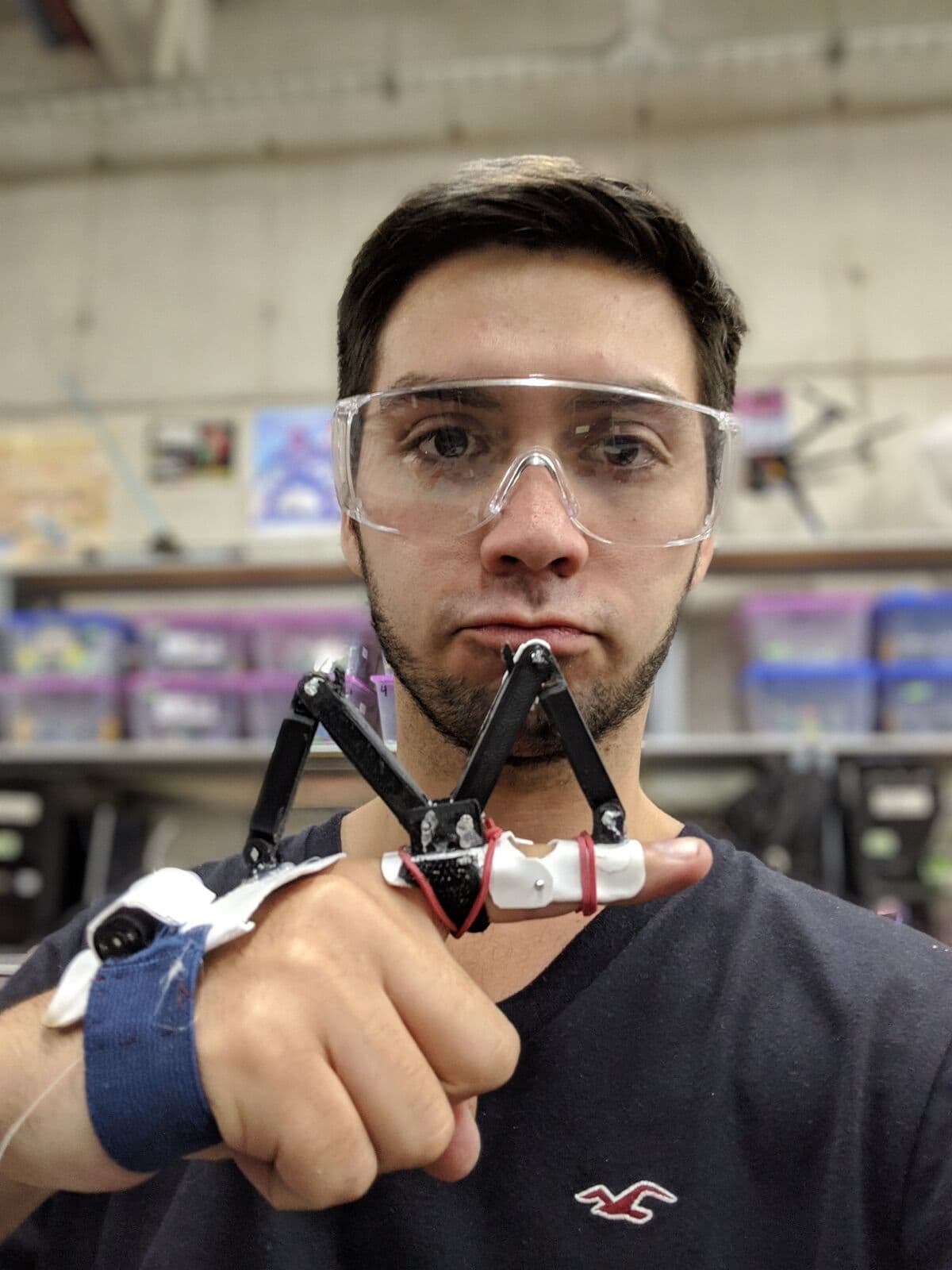
Flexor Metacarpophalangeal Exoskeleton
An EMG-driven hand exoskeleton that reads nerve signals before they fade, designed to give ALS patients back fine motor control.
Our BSc capstone, built by a team of three. The idea and the soft-robotics approach were mine, and I led the team. In the final version I did the mechanical design and most of the integration. The movement classifier was a teammate's work, trained partly on data from my sensor glove.
A clinical problem worth attempting
Around 5,000 people are diagnosed with ALS in the United States each year. The disease weakens the transmission of nerve impulses to the muscles, and hand mobility is one of the first things to go. Buttoning a shirt, holding a pen, picking up a fork: small acts that quietly disappear from everyday life.
We chose ALS for our capstone. The research phase included interviewing people living with the disease, which shaped what the device needed to do: detect the intended movement at the nerve, then complete the motion mechanically on the patient's behalf, both assisting them with daily tasks and stimulating muscles that would otherwise atrophy.
From soft robotics to a printed skeleton
We split the work across three domains: mechanical design, electronics, and software. Each of us researched a different way to move a finger, and I took the one I found most interesting: soft robotics actuators. Not rigid, able to adapt to the shape of a hand, and comfortable enough to wear all day. I had only read about the field before, so this was where I got to learn it by building.
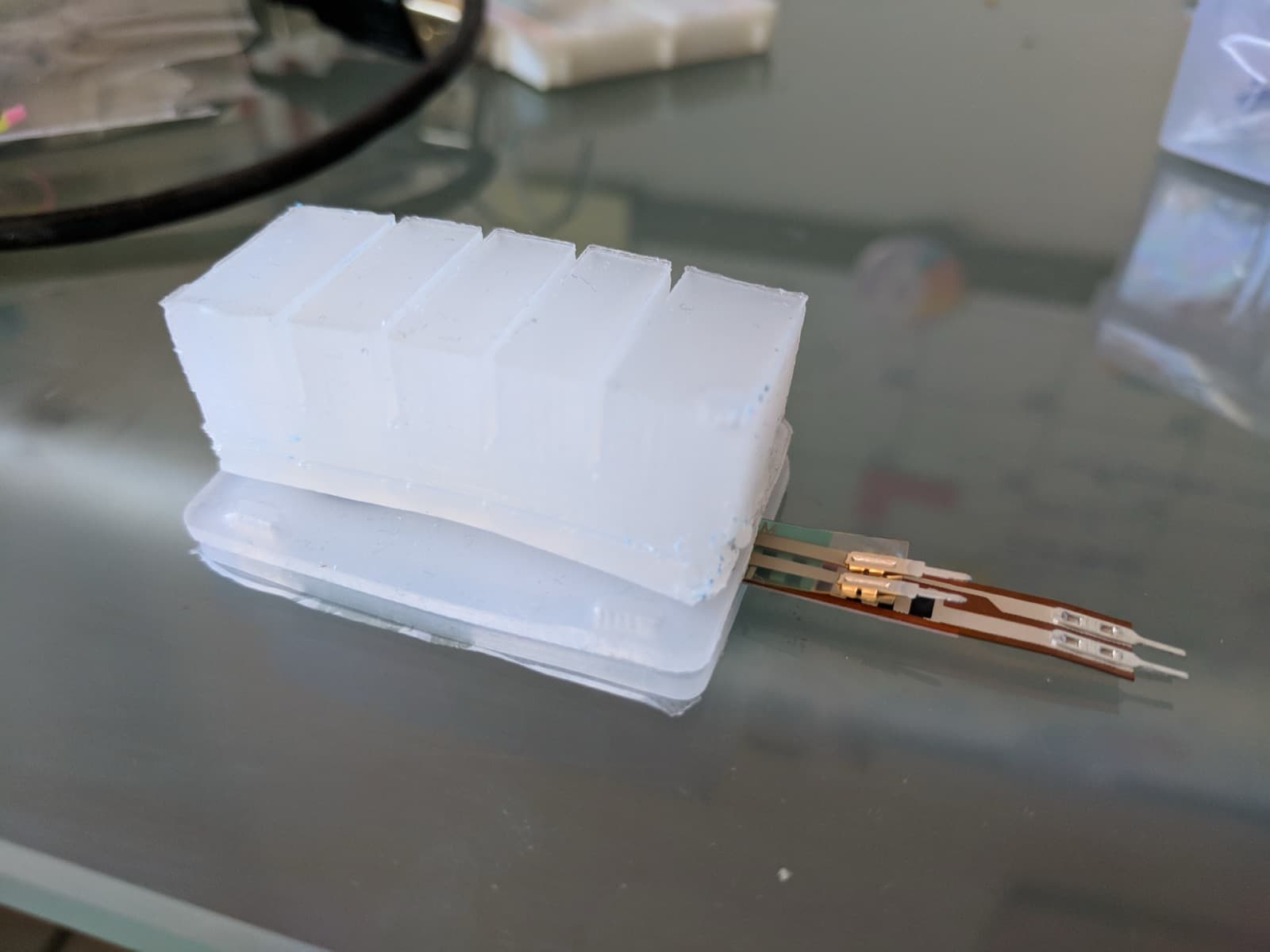
Following the Soft Robotics Toolkit, I sketched a pneumatic actuator, modeled a mold for it in Autodesk Inventor, and 3D-printed the mold. Then I cast the actuators in Ecoflex silicone. The fabrication was messy, and it took a few iterations and on-the-fly changes, but I landed on pneumatic actuators that worked: inject air through a needle and the silicone finger curls. I used rubber bands to apply pressure at specific points, guiding the motion and stopping the actuator from bulging where I did not want it to, and embedded a force sensor and a flex sensor in the silicone to read the movement and start closing the feedback loop.
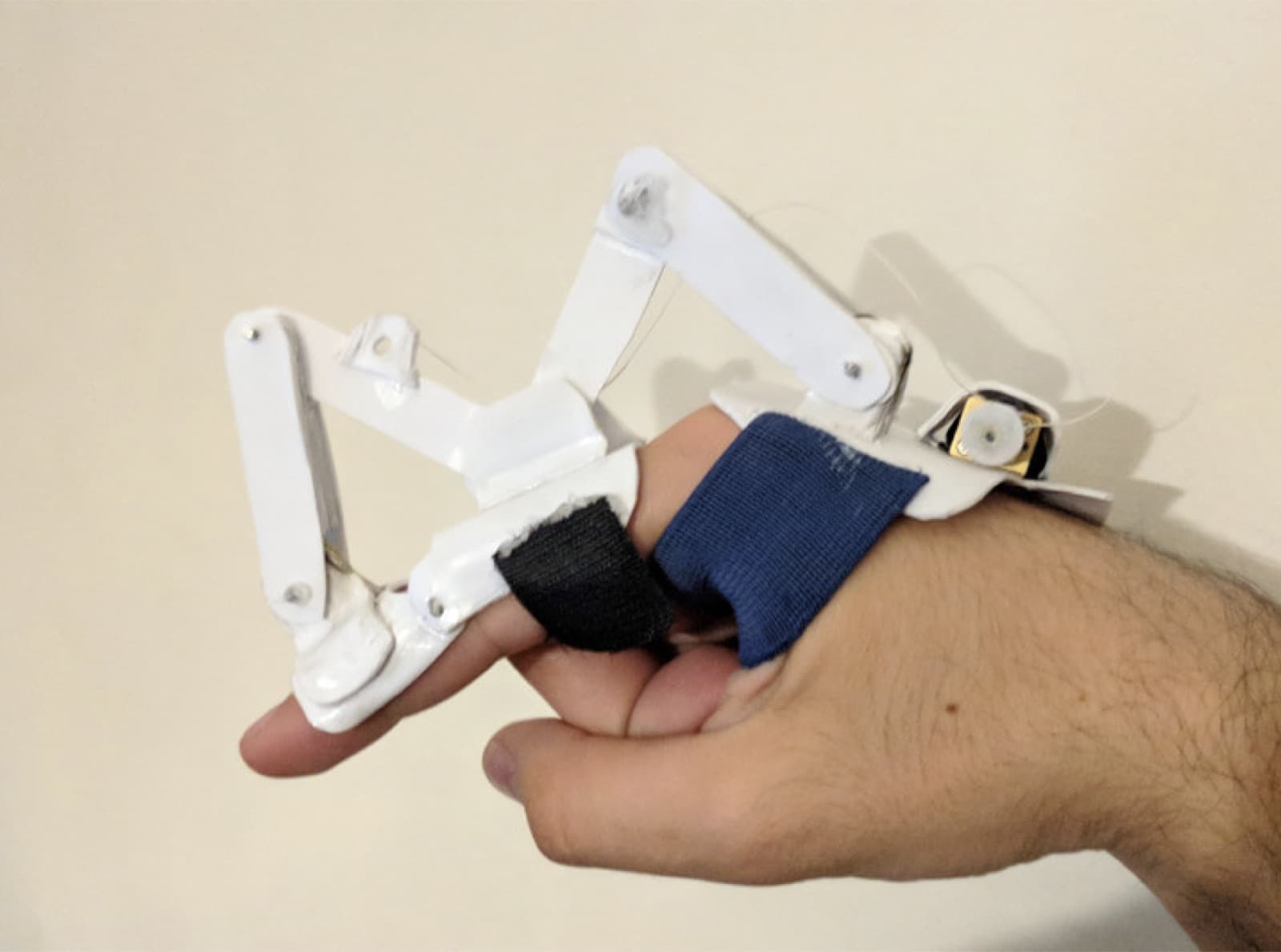
For all that, they could not push a real finger against real load with the force the device needed, and soft robotics is its own multi-year research field where we had a semester. So we pivoted to a 3D-printed exoskeleton with a motor-driven mechanical system, modular per finger (thumb, index, middle) so the device could be configured to whichever fingers a given patient was losing first.
Reading the nerve, closing the loop
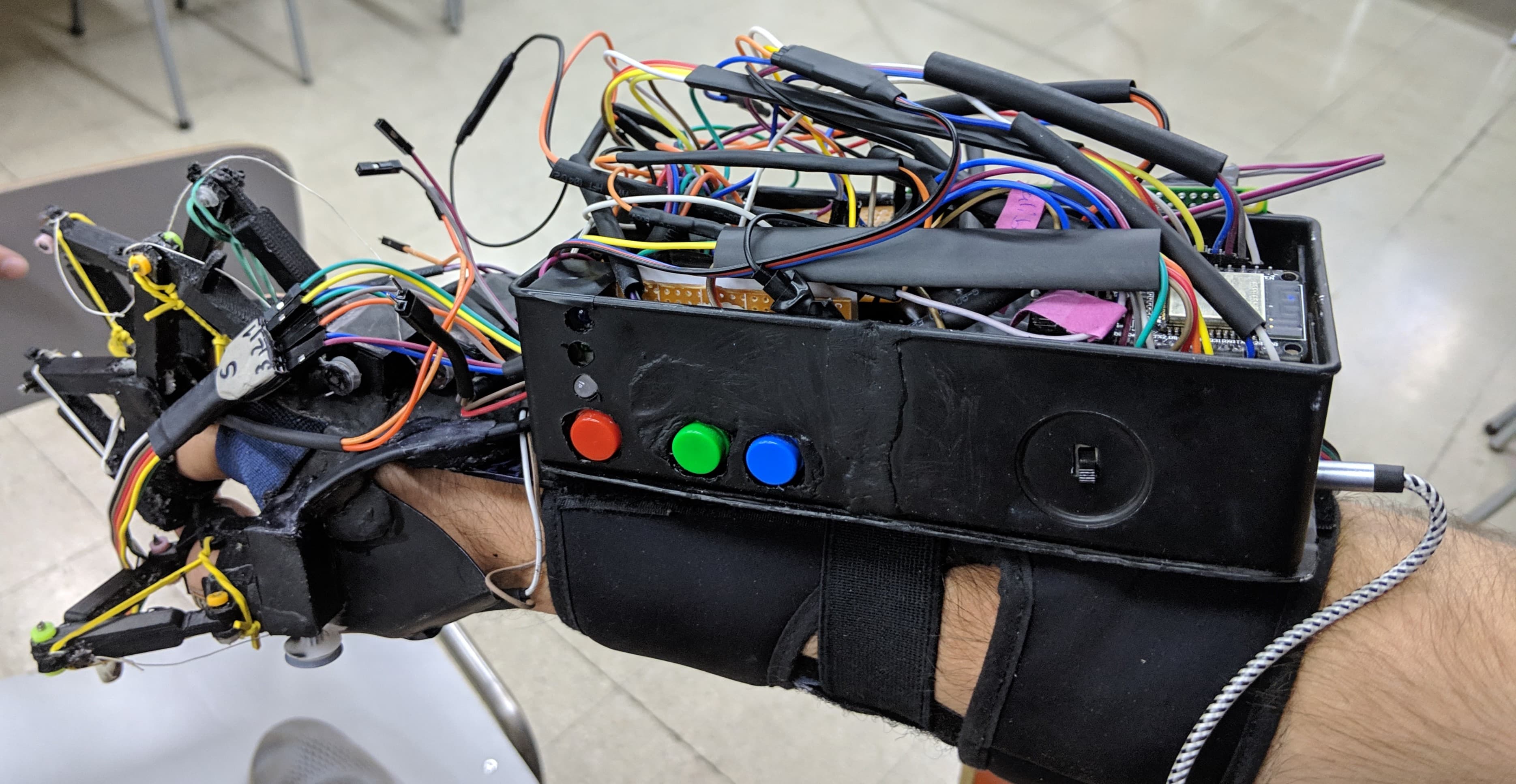
The signal chain ran from skin to motors. An electromyography (EMG) sensor picked up surface nerve activity, wrapped in an aluminum-foil Faraday cage to attenuate ambient electrical noise. The signal fed into an ESP32 microcontroller for filtering and packaging, which then handed it to a Raspberry Pi Zero running our classifier. The Pi made the decision, the ESP32 drove the motors.
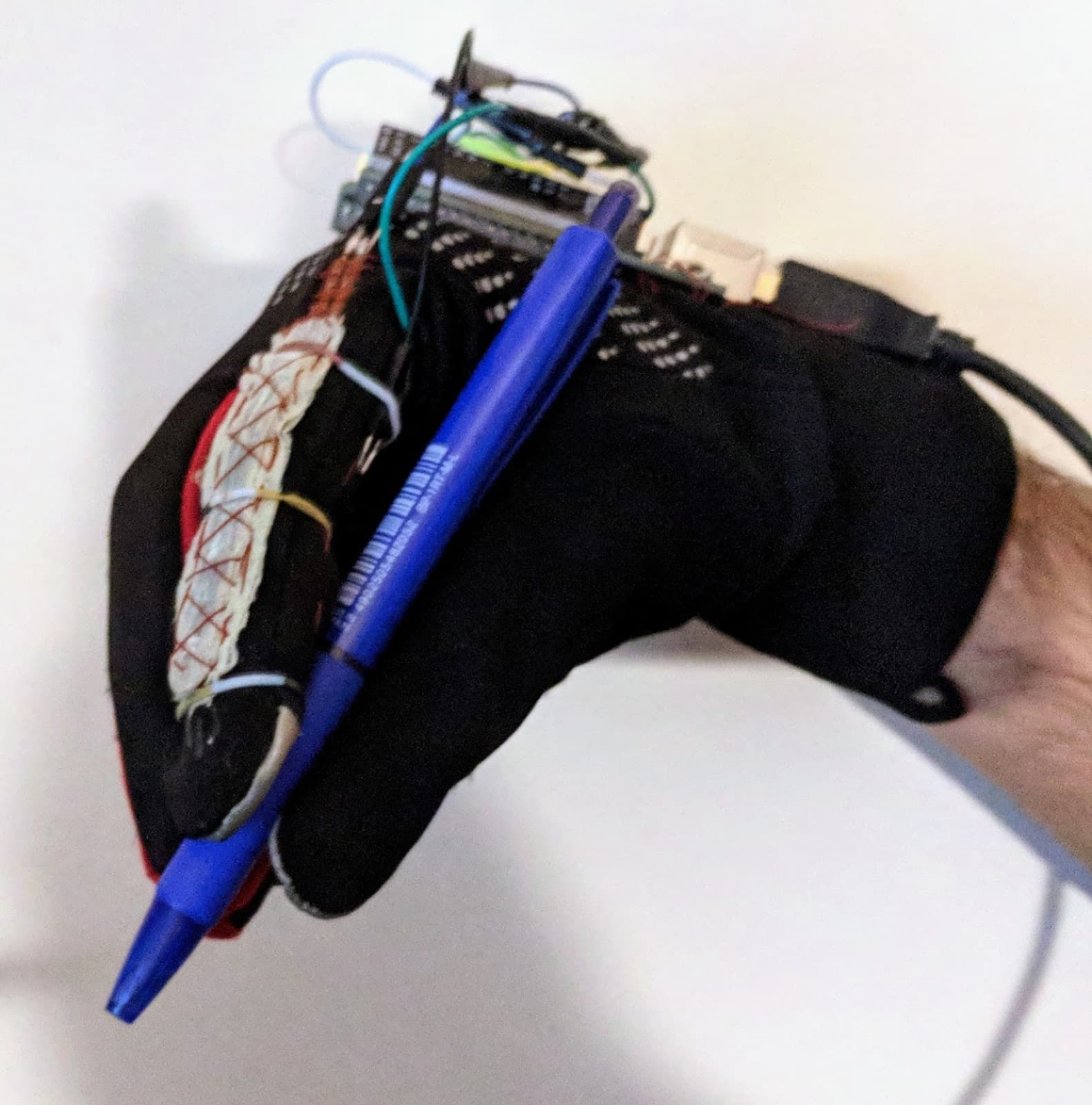
For closed-loop control we added flex and force sensors to each finger. Flex told us when the finger reached the target position, force told us whether it was actually holding something. To learn how those two sensors behaved in the real world, I built a separate instrumented glove and wore it through ordinary tasks: writing with a pencil, opening door handles. Watching the signal traces while doing each motion taught me more about sensor characterization than any lab exercise had.
Lithium batteries powered everything, so the system could go untethered. The whole goal was a person being able to wear it and forget it.
A small model that ran on the patient
We trained on the public sEMG for Basic Hand Movements dataset and converged on a simple feedforward neural network in Keras: a 512-unit ReLU layer into a SoftMax output over three movement classes, ten training iterations. Nothing exotic. We chose it for its combination of high accuracy and low latency on a Raspberry Pi Zero.
That second constraint is the one that stayed with me. The cleanest version of this system is the one where everything runs on the patient. No cloud call to wait for, no internet to depend on, no biometric data leaving the device. The same edge-first thinking that ParkHere had taught me on parking-spot occupancy was now running on someone's body.
What we shipped, what I kept
The final prototype worked. It read intended movements, classified them, and actuated the right finger with closed-loop confirmation. It was also heavy, bulky, and not something a real ALS patient would have wanted to wear for long. We knew that going in. Four months is enough to prove a system, not to ship one.
What stayed with me wasn't the prototype. It was the feeling of integrating across mechanical, electrical, and software domains for the first time on the same project, and the discovery that the interesting work always lives at the boundaries between them. Almost every project I've taken on since (LoRa networks, edge sensing, robot control apps) has been about that same boundary problem under a different name.